

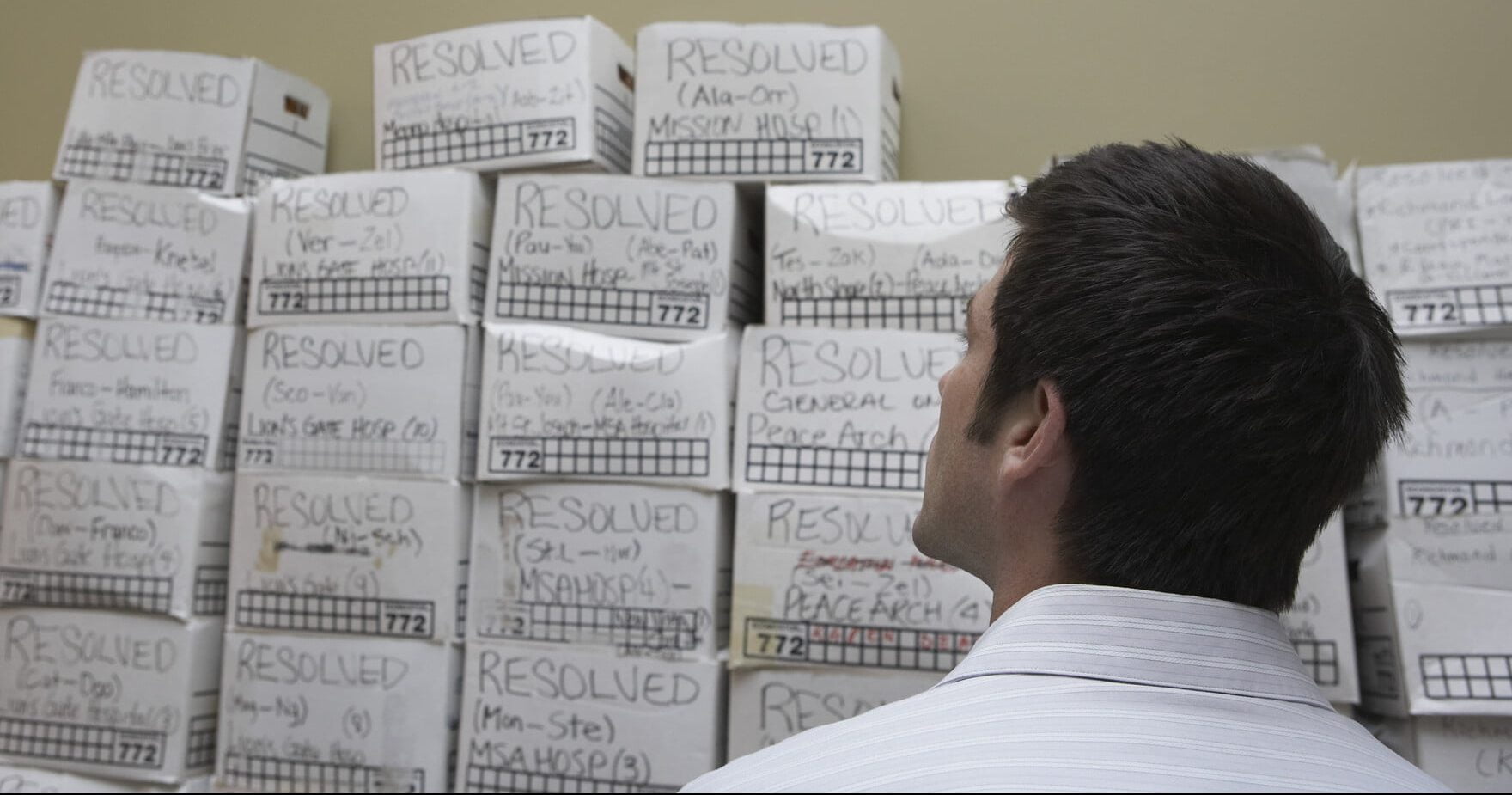
Every law office in metro Boston has the same back room. Closed files from matters nobody remembers, stacked in banker’s boxes, labeled in three different handwritings. Someone keeps saying they will deal with it after the next trial. Massachusetts already told you how: Rule 1.15A of the Rules of Professional Conduct sets how long you keep a client file and how you destroy it. This guide walks through the rule in plain language, shows where firms get tripped up and lays out a purge process you could defend to the Board of Bar Overseers.
By Erica McKowski, Compliance Manager · Updated November 2026 · 14-minute read
We are a shredding company, not a law firm. This guide explains the rule as written and is not legal advice. Check your own retention policy and malpractice carrier requirements before you destroy anything.
What Rule 1.15A actually says
Rule 1.15A covers client files. It took its current form after the Supreme Judicial Court amended it, and the version in force today is the one effective September 1, 2024. Before the rule existed, Massachusetts lawyers relied on bar advisory opinions and habit. Now there is a written standard, and it is short enough to read over coffee.
The core instruction is that a lawyer must take reasonable measures to keep a client file until a set period has run. For most matters that period is six years after the matter is completed or the representation ends. When the six years are up, and the client has not asked for the file, you may destroy it. The rule does not require destruction. It lets you keep files longer, and plenty of firms do.
Three points surprise people who read the rule for the first time.
- The rule does not require a notice to the client before destruction. It does encourage you to address file disposition in the engagement letter and the closing letter.
- The six-year clock starts when the matter is completed or the representation ends, not when you send the last bill.
- Destruction has to be carried out in a manner consistent with your confidentiality obligations. That one sentence is where a shredding company comes in.
The six-year clock and the cases that run longer
Six years is the default. Several situations push the date out.
Files for minors. If your client was a minor, the clock does not start until the client reaches the age of majority. You keep the file until six years after that birthday. A personal injury file for a seven-year-old stays on your shelf well into the client’s twenties.
Criminal and delinquency defense. The rule sets a longer period for these files. If the client received a death or life sentence, you keep the file for the life of the client. In every other case you keep it for ten years after the latest of three dates: the end of the representation, the conclusion of direct appeals, or the end of the maximum period of incarceration for a client who was locked up. The period never runs past the client’s life. Public defenders and other appointed counsel should also check the assigned counsel manual of the Committee for Public Counsel Services, which the rule points to for appointed work.
Longer rules elsewhere. Rule 1.15A says the longest applicable period controls. A court order, a discovery obligation, a subpoena or a statute might require you to keep material longer. Spoliation law sits on top of all of it. If another rule says ten years, ten years wins.
A written agreement with the client. A competent client might agree in writing to a different arrangement, such as a shorter retention period. Get it in writing and keep the writing. The rule does not let a guardian or parent waive protections for a minor in the same casual way.
Four things that stop you from destroying a file
Even after six years, the rule says you must not destroy a file if you know, or should reasonably know, that one of the following is true.
- A lawsuit or other legal claim is pending or anticipated.
- A criminal or governmental investigation is pending or anticipated.
- A disciplinary investigation or a Client Security Board claim is pending or anticipated.
- Less than ten years have passed since funds possibly related to the file were transferred to the IOLTA Committee under Rule 1.15.
The fourth item catches firms off guard. If a matter involved client funds and some of that money ended up unclaimed and sent to the IOLTA Committee, you hold the file ten years from the transfer, not six. Your bookkeeper knows whether any unclaimed funds went out. Ask before the purge, not after.
The word “anticipated” does real work in the first three items. You do not need a filed complaint. If a former client left angry and mentioned a lawyer, or a partner suspects a malpractice claim, the file stays. The rule also notes that you may destroy a file even though further proceedings are possible someday, as long as none are pending or anticipated at the time of destruction. That is a judgment call. Document who made it and when.
What to pull out before the file goes to the shredder
Not everything in a client file is paper you shred. Rule 1.15A singles out documents with value of their own, and getting this wrong is worse than keeping a box too long.
The rule calls them intrinsically valuable documents. Examples include original wills, trusts, executed estate planning documents, deeds, securities, negotiable instruments and official corporate records. If the document is trust property, you deliver it to the client under Rule 1.15. Other valuable originals must be safeguarded and delivered on request, or kept until they lose their value. If you cannot find the client, the rule tells you to securely retain these documents or deliver them to an appropriate government repository.
Build a pull list for every purge. Before a box is sealed, a lawyer or paralegal checks for:
- Original signed wills, codicils and trust instruments
- Deeds, mortgages and recorded instruments with original signatures
- Stock certificates, bonds, notes and other negotiable paper
- Corporate minute books, seals and stock ledgers
- Client property, such as jewelry, passports or keys
- Anything under a court seal or protective order
Also separate the file from the firm’s own administrative records. The rule’s commentary treats conflict checks and billing records as the firm’s records, not the client’s file. They follow your own retention policy and tax rules, which is a separate decision. If you keep them for seven years for tax reasons, nothing in Rule 1.15A stops you.
Trust account records follow Rule 1.15
Records tied to client funds live under a different rule. Rule 1.15 governs trust property and the accounts that hold it, including IOLTA accounts. The standard guidance is to keep those records for six years after the representation ends and the property is distributed. Bank statements, deposit records, ledgers and reconciliations all belong in that group.
Keep the two sets of records apart in your storage. A client file box that contains a trust ledger is two retention periods in one carton, and someone will eventually pull the wrong date. Index trust records separately and give them their own destruction log.
The confidentiality duty is the part people forget
Paragraph (h) of Rule 1.15A tells you to take reasonable measures to ensure destruction is carried out consistent with all applicable confidentiality obligations. The commentary points to Rules 1.6 and 1.9, Massachusetts General Laws chapter 93H and the HIPAA Privacy Rule.
Here is what each one means for a box of old files.
- Rule 1.6 covers information relating to the representation of a client. Rule 1.9 carries that duty to former clients. A closed file is still confidential, forever.
- Chapter 93H is the Massachusetts data breach statute. If paper files holding names with Social Security numbers, financial account numbers or driver’s license numbers are lost or exposed, you face notice duties. Our guide to 201 CMR 17.00 covers the companion regulation, which requires proper disposal of paper records with personal information.
- HIPAA reaches personal injury and medical malpractice files that contain protected health information, especially if your firm acts as a business associate. See our medical and HIPAA shredding page for how we handle that material.
A recycling bin does not meet that standard. Neither does a dumpster behind the building, a home strip-cut shredder run by a summer intern or a pile of boxes left for the building’s trash pickup. Each of those leaves readable client information in places you do not control.
A purge process you could defend to the Board of Bar Overseers
Most firms do not get in trouble for keeping too much. They get in trouble when they destroy the wrong file or cannot show how they decided. A simple written process fixes both. Here is the one we see work at small and mid-size firms around Boston, Lowell and the Merrimack Valley.
Step 1: Adopt a written retention policy
Put the six-year default, the minor and criminal extensions and the IOLTA ten-year rule into one page. Say who approves destruction. In a solo practice that is you. In a firm it is usually a managing partner or a records committee. Add the policy to your engagement letter so clients see it on day one.
Step 2: Close files with a date
Every file needs a closing date on the cover. Without one, you cannot compute the six years. When you close a file, record the matter type, the client’s age if a minor was involved, whether client funds were ever held and the earliest destruction date. Put the earliest date on the box label.
Step 3: Run a yearly review
Pick a month. Many firms choose the quarter after year-end billing closes. Pull every box whose destruction date has passed and run each file through a short checklist: any pending or anticipated claim, any investigation, any IOLTA transfer in the last ten years, any minor client, any longer rule from a court or statute.
Step 4: Pull the originals
Use the list from the section above. A paralegal opens each file, removes intrinsically valuable originals and logs them. Those items go to the client, a vault or a government repository as the rule directs.
Step 5: Get a second sign-off
The approving lawyer signs a destruction authorization that lists the matters or box numbers. Keep that list permanently. It is your proof that a lawyer made a deliberate decision, and it answers the question “what happened to the Hennessy file?” years from now without anyone having to remember.
Step 6: Destroy with a documented vendor
Seal the boxes and move them under your control to a professional shredder. Ask for a Certificate of Destruction that states the date, the volume and the method. File it with the authorization list. We cover what that certificate proves on our Certificate of Destruction page.
Step 7: Update your index
Mark each destroyed matter in your file index with the date and the certificate number. Keep the index itself. If a former client calls in year eleven asking for a file, you want to answer in one minute and show the paper trail.
Do not forget digital files and hard drives
The rule talks about the client file, and most client files today are part paper and part electronic. Scanned documents, email folders, document management systems and the copier hard drive all hold client information. When paper goes, the electronic copy should follow the same retention date, or you have destroyed the paper and left the risk sitting on a server.
Old laptops, external drives and copier hard drives deserve special attention. Deleting files does not remove them. Retired media needs physical destruction. We shred hard drives for $9 per drive with a $79 minimum, and each one is listed on the Certificate of Destruction. See our hard drive destruction page for the process.
Choosing how to destroy the paper
You have three realistic options for a purge. Each has a place.
Drop-off. You load the boxes in a vehicle and bring them to our Tewksbury plant at 1215 Main Street, Unit 115. We are open Monday to Friday from 10 to 1 and 2 to 6. The price is 99 cents per pound with no minimum, plus a $14.95 HIPAA fee and a $19.95 environmental fee per job. A typical banker’s box weighs about 30 pounds, so 40 boxes is roughly 1,200 pounds, or about $1,223 all in. Details are on our drop-off shredding page.
Off-site pickup. If you have more boxes than your staff wants to carry, we pick up from your office anywhere in our 14-city service area. Pickup adds a $129 transport fee to the same per-pound rate. For 40 boxes, that brings the total to about $1,352. Boston, Newton, Waltham, Lexington, Burlington, Andover, Lowell and the rest of the region are covered. Our off-site shredding page explains how pickup works.
Witnessed shredding. Some firms want a lawyer or paralegal to watch their own files go through the shredder. At our plant you stand at the viewing window and see the boxes fed in. That fits matters with high sensitivity, such as a family law file or a sealed matter. See witnessed paper shredding for how it runs.
For firms with a steady stream of closed files, ask about a recurring plan with locked consoles in the office. It removes the back-room pile before it forms. Our business shredding page covers recurring service.
Where this matters across metro Boston
The rule is statewide, but the practical problems differ by town. Downtown Boston firms pay premium rent on file storage and often hold decades of paper offsite. Solo and small practices in Lowell, Lawrence, Haverhill and Methuen tend to keep files in a basement or a rented unit, where moisture and fire are the risks. Suburban firms in Lexington, Waltham, Burlington and Andover often run out of closet space first.
We serve all of them from the Tewksbury plant. Local pages cover Boston, Waltham, Lexington and Andover, among others. Tewksbury sits close to Routes 38, 495 and 93, which keeps drop-off trips short for firms north of Boston.
Five mistakes we see on law firm purges
Counting from the wrong date. The clock starts at the end of the matter or representation. A file whose last bill went out in 2017 may have closed in 2019. Use the closing date.
Missing the minor client. A file with an adult guardian on the cover and a child in the case caption is a minor file. Check the caption before you check the year.
Forgetting the IOLTA rule. A ten-year hold applies when funds possibly related to the file went to the IOLTA Committee. Ask your bookkeeper first.
Tossing the originals. A will signed in 2004 is not a six-year document. Pull every original before the lid goes on.
Leaving no record. A purge with no authorization list and no certificate is a purge you cannot explain. Take the extra ten minutes and file the paperwork.
What a purge costs next to what it saves
Storage is the hidden bill. Commercial records storage charges by the box every month, and a firm with 200 boxes in a vault pays that fee year after year for paper nobody will read again. Shredding 200 boxes, about 6,000 pounds, costs roughly $5,975 at our drop-off rate. For a firm paying a few hundred dollars a month in storage, the purge pays for itself inside two years, and it shrinks the pile of client data that can leak.
The other side of the ledger is risk. A malpractice claim you cannot defend because the file is gone is a bad day. So is a data breach notice for files you should have destroyed in 2020. The retention policy and the purge process exist to protect you from both.
Frequently asked questions
How long must a Massachusetts lawyer keep a client file?
Do I have to notify the client before destroying a closed file?
Which documents can a lawyer never shred?
What blocks destruction even after six years?
How long do trust account records stay?
Does the confidentiality duty apply to a closed file?
How much does it cost to shred 40 boxes of closed files?
Can we watch our files being shredded?
What proof should the firm keep after a purge?
Clear the back room with a paper trail
A closed file is a liability that grows quieter every year, until someone asks about it. The fix is a written policy, a yearly review and a purge you can document. Start with one shelf if the whole room feels like too much.
We are a family-owned shredding company in Tewksbury, serving businesses across metro Boston since 2007, with a 4.9-star rating from 87 verified reviews. Call (978) 636-0301 and we will help you size the job, choose between drop-off, pickup and witnessed shredding, and set up the paperwork your authorization list needs. Every job comes with a Certificate of Destruction.
Related reading: How to build a document retention policy · How long to keep important records · Massachusetts privacy law explained
